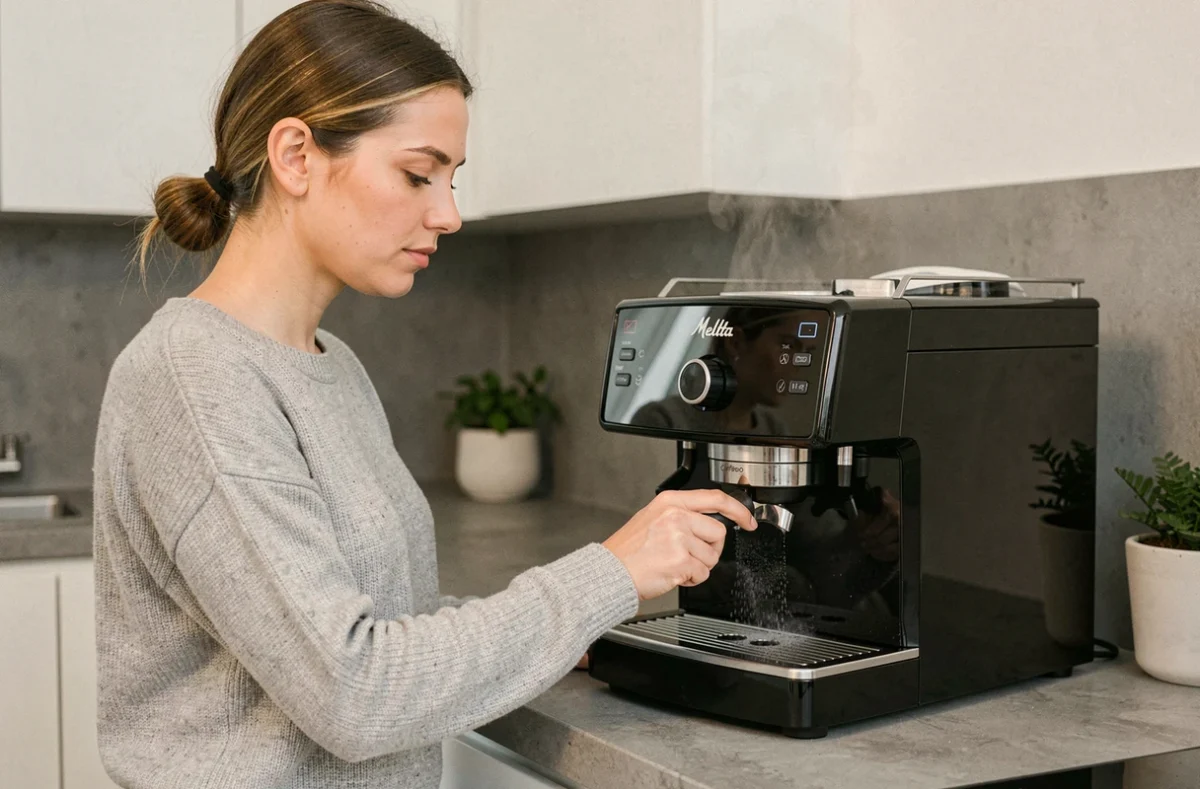
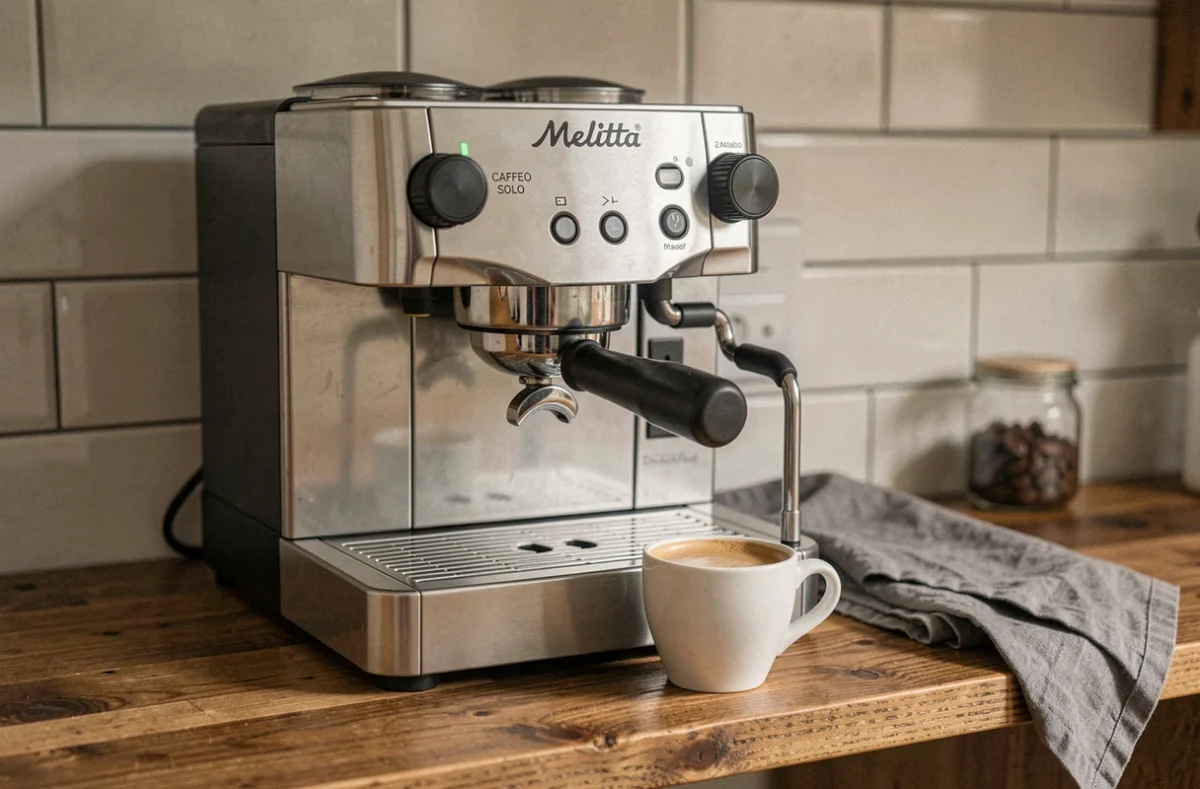
The Melitta Caffeo Solo is a compact bean-to-cup espresso machine designed for daily home use. Its small size and simplified interface (two main buttons) appeal to users who want freshly ground coffee without complex operations. Behind this apparent simplicity, a few adjustments and maintenance actions directly affect the cup quality and the longevity of the device.
Grinder Adjustment and Temperature: What the Manual Doesn’t Detail Enough
The grinder of the Caffeo Solo offers several grind levels, accessible via a dial located inside the bean compartment. Changing this setting while the grinder is running is the only method recommended by Melitta to avoid blocking the burrs.
A finer setting slows down the flow and produces a stronger coffee. Conversely, a coarser grind speeds up extraction and results in a lighter brew. User feedback indicates that it often takes two or three coffees after each change before the new grind stabilizes in the cup.
The water temperature is also adjustable via the menu. With very hard water, a high temperature accelerates tartar formation in the circuit. For most medium-roasted coffee beans, the middle position is a good starting point. You can find all the settings in the manual for the Melitta Caffeo Solo, which details each step of navigation through the menus.
Maintenance of the Caffeo Solo: Descaling, Cleaning, and Extraction Chamber
Regular maintenance consists of three distinct actions, each targeting a different part of the circuit.
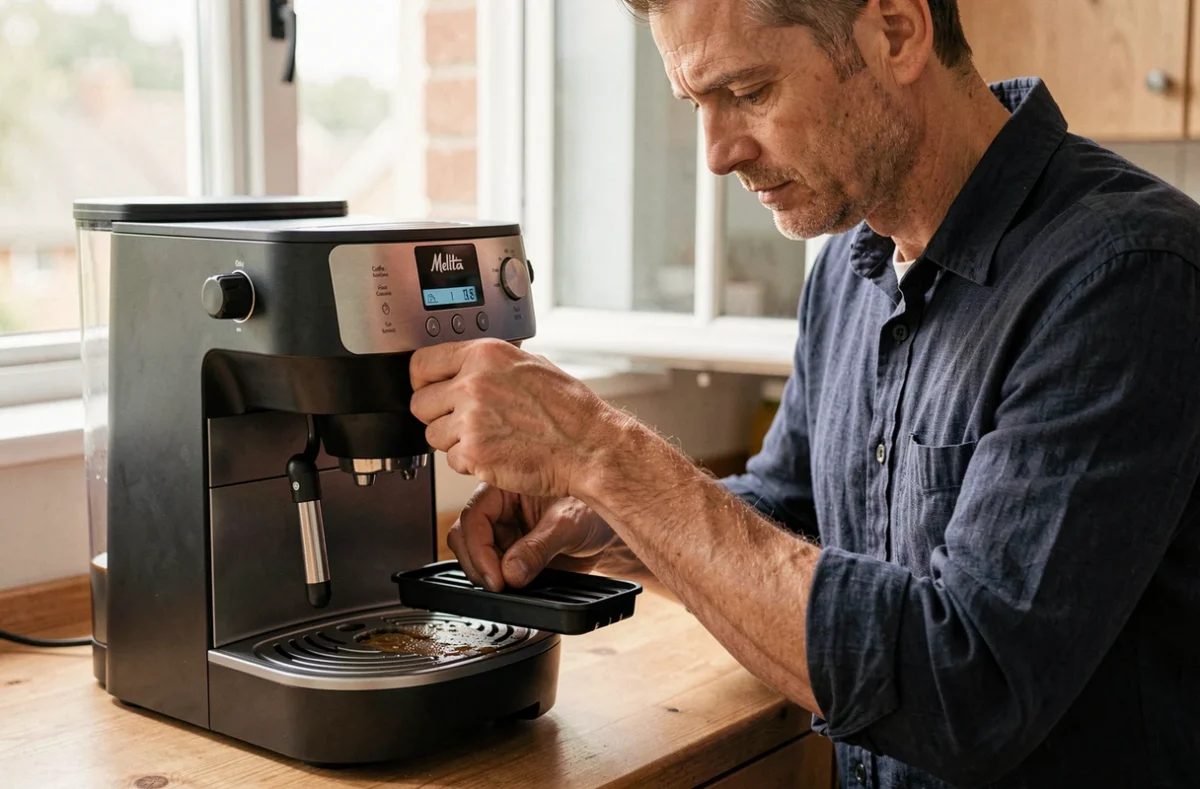
- The removable extraction chamber is removed from the side of the machine. A rinse with clear water after each week of use is sufficient to prevent the accumulation of coffee residues that eventually harden and obstruct the mechanism.
- The automatic cleaning program, initiated from the control panel, circulates a cleaning tablet through the internal circuit. This cycle removes oxidized coffee oils that alter the taste.
- The descaling follows a dedicated program, indicated by a light on the machine. Repeatedly ignoring this warning exposes the hydraulic circuit to gradual clogging, identified in user feedback as a common cause of failure.
The Pro Aqua filter, inserted in the water tank, reduces the frequency of descaling by filtering some of the hardness. Its replacement is necessary after a few weeks of intensive use, depending on your water hardness.
Common Failures of the Melitta Caffeo Solo: Symptoms and Diagnosis
Some issues frequently arise in user feedback, without always appearing in standard maintenance guides.
An unusual noise during grinding may indicate a foreign object (a small stone in the beans) or wear of the burrs. In the first case, cleaning the compartment resolves the issue. In the second, replacing the burrs is possible but depends on the availability of parts.
An abnormally high water consumption for a small volume of coffee often signals a partially scaled circuit. Descaling usually corrects this symptom. If the problem persists after two cycles, the hydraulic block may be at fault.
The quality of the foam (for variants equipped with a steam wand) may degrade over time. Clogging of the wand by dried milk residues is the most common cause, and soaking in hot water is sufficient in most cases.
When to Stop Repairing Your Caffeo Solo
The actual lifespan of a Caffeo Solo is not independently documented. User feedback varies on this point, with some users reporting several years without incident, while others report recurring failures after the warranty period.
The brewing group (extraction chamber and its components) is the most stressed part. Its replacement represents a significant cost compared to the purchase price of the machine. When the cumulative cost of repairs exceeds half the price of a new machine, the question of replacement becomes concrete.
Several criteria can help structure this decision:
- The age of the machine: beyond the legal warranty, spare parts may become difficult to find, especially for older models (E950, for example).
- The frequency of failures: a first isolated failure justifies a repair. Two different failures within a few months suggest widespread wear.
- The actual availability of parts: check before ordering if the brewing group, seals, or burrs are still listed with specialized distributors.
- The cost of the repair compared to the price of a new or refurbished equivalent model. A repair that exceeds one-third of the new price deserves consideration.
The available data does not allow for a universal threshold. The decision also depends on your attachment to the compactness of the Solo, a format that few competitors offer in this price range.
One last point rarely addressed: the commercial warranty varies by seller and purchase date. Always check your specific conditions before incurring repair costs, as some extensions cover the brewing group, while others do not. A well-maintained Caffeo Solo can last a long time, but maintenance does not indefinitely postpone the mechanical wear of moving parts.