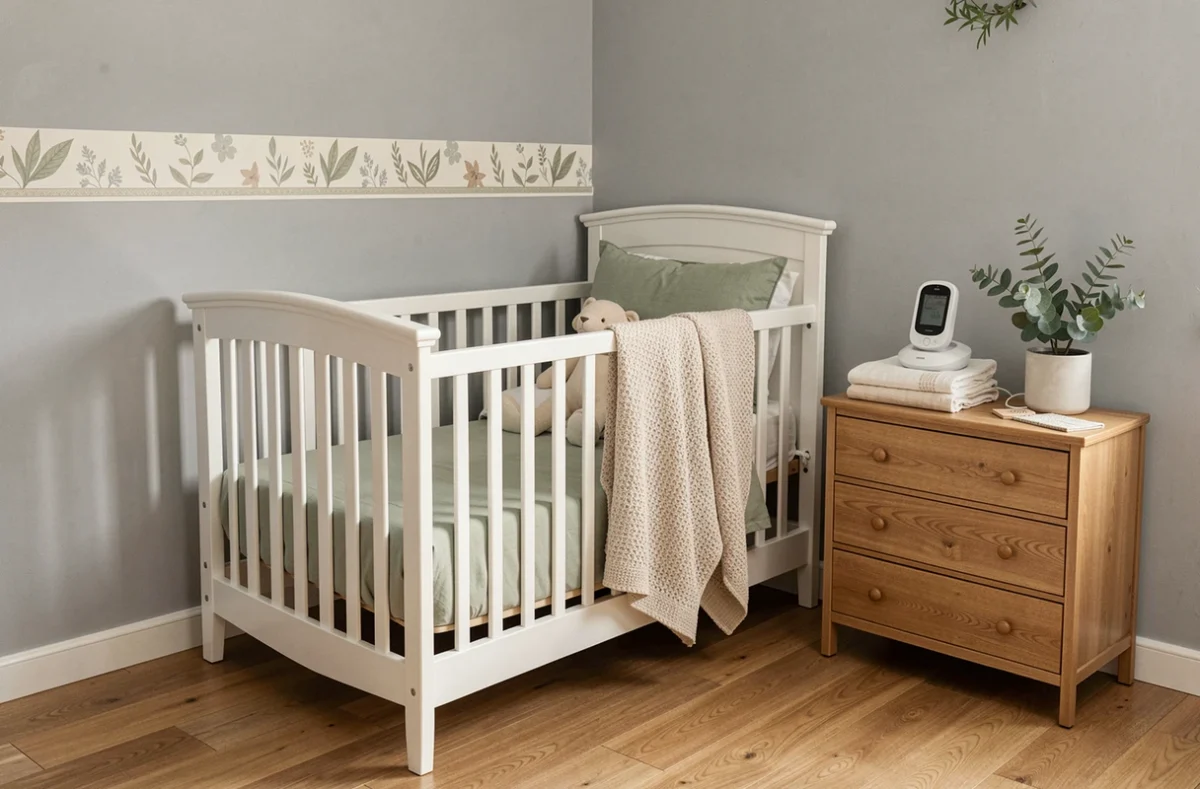
The safe sleeping arrangement for infants does not begin in a separate room. French recommendations suggest that the baby sleeps in the parents’ room, in their own bed, for at least the first six months. Creating a comfortable and practical nursery therefore requires thinking in two stages: first, a temporary sleeping space near the parents, and then a dedicated room where each element meets specific safety and functionality criteria.
Wall fastening and furniture anchoring: the overlooked technical point
The stability of furniture is an essential safety requirement distinct from aesthetic choice. Dressers, low bookshelves, and drawer units become climbing supports as soon as the baby starts to move. Anchoring to the wall should be done upon installation, not when the child is standing.
We recommend anti-tip fasteners with metal straps and anchors suitable for the type of wall (drywall, brick, concrete). Kits provided by furniture manufacturers are often undersized for drywall partitions. Checking the nature of the wall before purchasing the furniture avoids discovering, on the day of assembly, that a storage dresser cannot be secured properly.
This precaution also applies to changing tables if they are integrated into a tall piece of furniture. An unsecured changing unit, loaded with diapers and care products, has a high center of gravity that makes it particularly unstable.
To explore suitable furniture and bedding choices for the first months, you can visit the Maman m’adore website which details the essentials by category.

Baby bed and mattress: safe sleeping standards
The mattress must fit perfectly within the internal dimensions of the bed, with no residual space between the edge of the mattress and the walls. A gap of more than two fingers between the two surfaces creates a risk of entrapment for the infant’s face.
The choice of mattress is based on its firmness. A mattress that is too soft, such as memory foam, is not suitable for infants: the head can sink in and obstruct breathing. We find that high-resilience polyurethane foam or coconut fiber mattresses offer the best firmness-comfort compromise for safe sleeping.
What does not belong in the bed
No cushions, comforters, bumper pads, or stuffed animals should be in the sleeping space. A sleep sack replaces the blanket. It should be chosen based on the room temperature and the season, with an appropriate TOG rating.
- Light TOG for a room maintained around 19-20 °C, which corresponds to the recommended range for infant sleep
- Thicker TOG only if the temperature drops significantly below, ensuring that the baby does not sweat at the neck
- No layering of sleep sack + blanket, which negates the safety benefit of the system
Temperature and air quality in the baby’s room
The ideal room temperature is around 19 °C. Beyond that, the risk of overheating increases, which is an aggravating factor in sudden infant death situations. A reliable wall thermometer is part of the basic equipment for the room.
Ventilation plays an equally important role. Airing the room daily, even in winter, helps to refresh the air and reduce the concentration of volatile organic compounds (VOCs) emitted by new furniture, paints, and textiles. We recommend installing furniture and painting the room several weeks before the baby’s arrival to allow initial emissions to decrease.
Air purifiers do not replace effective mechanical or natural ventilation. Opening the window remains the simplest and most effective action to improve indoor air quality.
Changing area and storage: functional organization of the room
The changing area should be thought of as a workstation. Everything must be within reach without taking your eyes off the baby or losing physical contact. The rule is strict: one hand must always remain on the child during the change.
The changing surface, whether placed on a dresser or integrated into a dedicated piece of furniture, should be at elbow height to limit back pain. Storage for diapers, cottons, and care products should be organized in drawers or open baskets that are immediately accessible, not in a closet that requires opening with one hand.
Adaptable storage and dual-purpose furniture
Investing in a standard storage dresser rather than a dedicated changing table extends the lifespan of the furniture. A removable changing pad can be placed on top during the first months and then removed. The dresser can then be used for the child’s clothes for several years.
- Prefer furniture whose depth slightly exceeds that of the changing surface to ensure overall stability
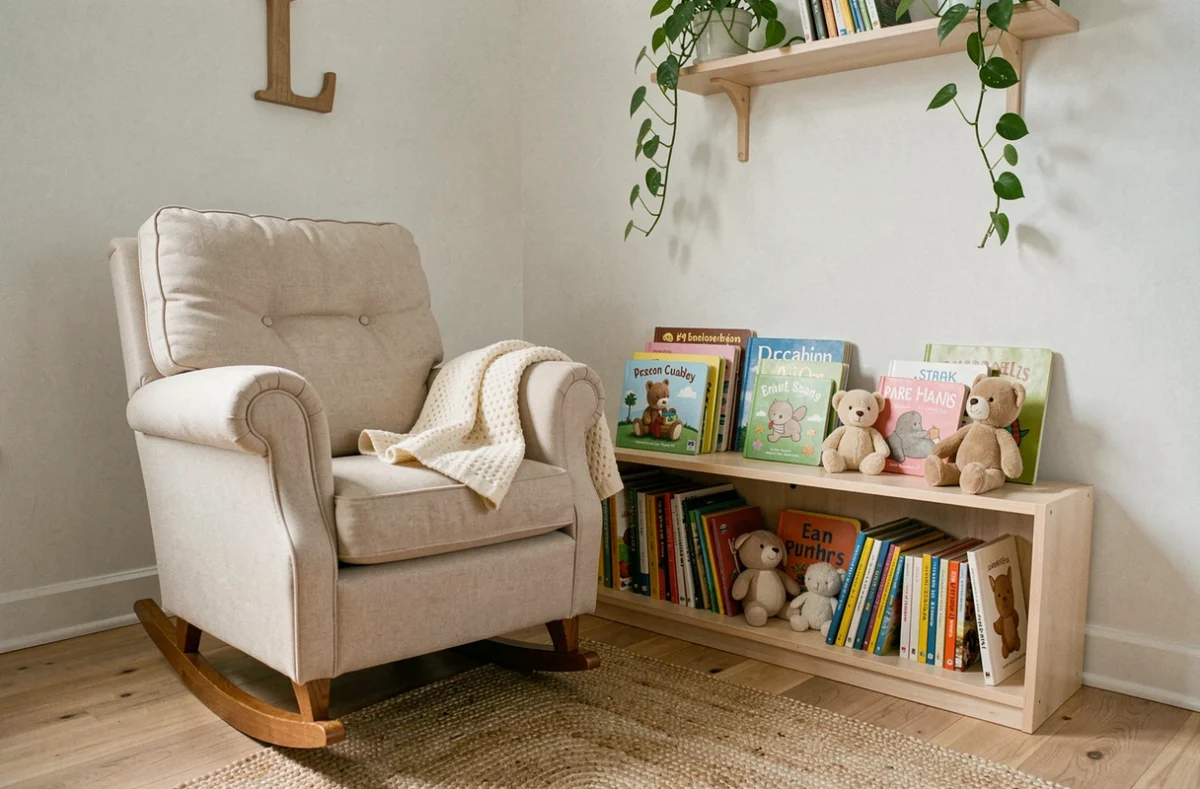
- Avoid low open shelves accessible as soon as the child crawls: they become sources of danger and permanent disorder
- Plan for a clear floor space for play, even in a small room, by limiting the number of pieces of furniture to the bare minimum
Designing a nursery is more about technical details than decoration. A well-fitted mattress, wall-anchored furniture, controlled temperature, and an ergonomic changing station meet the real needs of the infant and parents. The rest, such as developmental toys, mobiles, and night lights, will gradually complete the space based on the child’s interests.