
Mastering the rules of divisibility may seem daunting at first, but with a playful approach, children can quickly turn this skill into a fun game. Mathematics offers simple methods and tips to recognize if one number is divisible by another, making operations less complex. From mnemonic tricks to educational games, the tools for learning these rules are varied and suitable for all ages. By integrating these concepts interactively, students gain confidence and skills, deciphering the mysteries of numbers with ease and enthusiasm.
The Secrets of Numbers: Learning to Divide Easily
Break down multiples and divisors, fundamental concepts in mathematics, to spark the curiosity of CM1 and CM2 students. A multiple is defined as the product of a number by an integer. The multiples of 6 are easily identified, from 6, 12, 18, to infinity. Teach children how to recognize them through progressive exercises and engaging games. The multiple dice game, for example, confronts students with these concepts in a fun way, reinforcing their understanding without overwhelming them with the rigidity of traditional learning.
As for divisors, they represent the numbers by which another number is divisible without a remainder, a pillar of Euclidean division. Master Lucas, an innovative teacher, suggests educational resources that transform the search for divisors into an exciting quest. On his site maitrelucas.fr, explore worksheets and videos that enlighten students on this quest for divisible numbers. These resources break down the complexity of division, providing children with the keys to unlock the doors of divisibility.
The divisibility rules serve as essential markers for navigating the world of numbers. The sum of the digits of a number, for example, determines its divisibility by 3 or 9. Teach students to apply these criteria with agility, so they can, at a glance, establish the potential quotient of a division. Mind maps, visual synthesis tools, can illustrate these rules, allowing children to memorize them more effectively. Educational resources, such as those developed by Master Lucas, play a crucial role in this educational approach, transforming division into a stimulating intellectual adventure.
Fun Tips to Master Divisibility
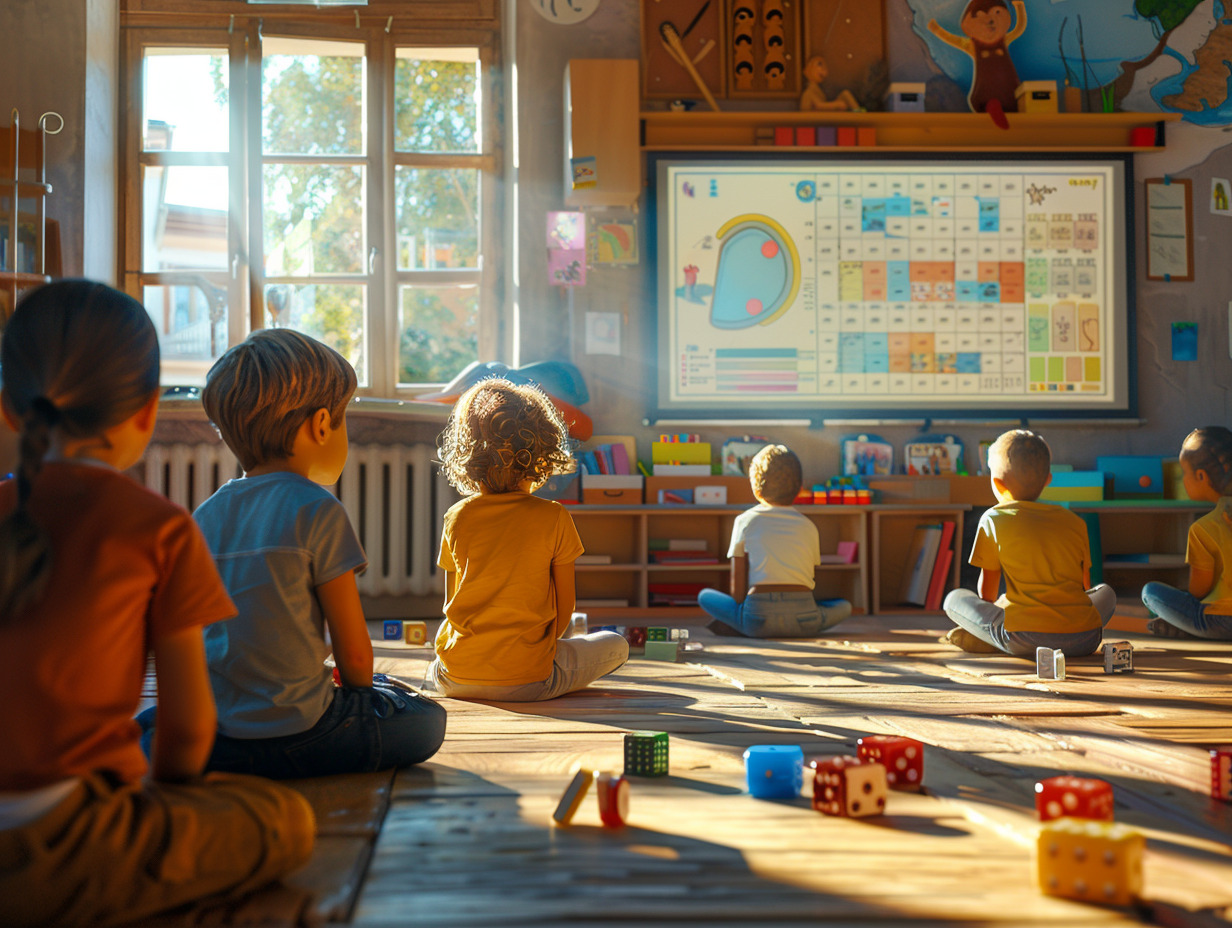
Through educational games, mastering the rules of divisibility is part of a renewed pedagogical approach that goes beyond the austere framework of the blackboard. Invoke the ‘Number Ogres’ in exercises, these fictional characters that only feed on multiples of 3 or 5. Surely, the children, CM1 and CM2 students, get into the game, their imagination guiding them toward a deeper understanding of mathematical concepts. The game ‘The Multiple Dice’ proves to be a valuable tool: by rolling the dice, participants identify the multiples and apply the divisibility criteria in an atmosphere of challenge and camaraderie.
In terms of educational resources, the video emerges as a dynamic support, capturing students’ attention. Master Lucas, a teacher and creator of educational content, has successfully integrated this medium into his teaching approach. On his site, maitrelucas.fr, discover videos that transform mathematical abstraction into animated stories, where numbers come to life. These multimedia supports, in addition to traditional worksheets, facilitate the memorization of divisibility rules through visualization and interactivity.
The mind map proves to be an indispensable tool for structuring and synthesizing acquired knowledge. Its use promotes the organization of knowledge around multiples, divisors, and divisibility criteria. It allows children to visualize the connections between concepts, thus facilitating the recall and application of mathematical rules. Mind maps, combined with worksheets, constitute a comprehensive learning method that blends reflection and enjoyment, preparing students for a solid mastery of mathematical fundamentals.