A parent who forgets to take their medication, a neighbor who hasn’t left their house in weeks, a mother who refuses to talk about her difficulties in climbing the stairs. Supporting a senior on a daily basis often involves navigating between respecting their autonomy and maintaining discreet vigilance. The answers are not always found in official guides, and best practices evolve quickly.
Adapting seniors’ housing: what really changes the game
Have you ever noticed that a simple poorly secured rug can turn a hallway into a trap? Adapting housing has become the primary lever for maintaining independence at home, well before human assistance. Recent institutional content, particularly from the National Old Age Insurance Fund, now places home modification at the center of fall prevention.
Specifically, three areas concentrate the majority of domestic accidents among the elderly:
- The bathroom: installing a grab bar near the shower or replacing a bathtub with a walk-in shower reduces the risk of slipping, the leading cause of emergency room visits related to the home
- The stairs: automatic motion-sensor lighting, combined with non-slip stair treads, secures nighttime movements without heavy renovations
- The kitchen: reorganizing storage so that everyday items are accessible between waist and shoulder height avoids dangerous stretching movements
These adjustments may seem modest. However, their cumulative effect transforms a risky home into a space where aging remains viable. Platforms like seniorsdesinfos.fr regularly compile feedback and financial assistance programs related to these modifications.
Identifying subtle signals of loss of autonomy
Loss of autonomy does not occur overnight. It begins with discreet signals that those around tend to minimize. An unopened administrative letter for several weeks. Grocery shopping becoming less varied. Hygiene slipping without apparent reason.
The ICOPE program, promoted by the World Health Organization, recently offers a structured approach to detect these signals early. The idea is to regularly assess five functions (vision, hearing, mobility, memory, mood) rather than waiting for a crisis.
In practice, a family caregiver can observe a few simple indicators during their visits:
- Does the person get up from their chair without support? If they consistently use the armrests, their muscle strength is declining
- Do they repeat the same questions within a few minutes? A momentary lapse is normal, but repetitive questioning warrants medical advice
- Have they lost weight without changing their diet? Unintentional weight loss in a senior often signals an underlying nutritional or medical issue
- Does their refrigerator contain a significant number of expired foods? This is a reliable indicator of daily disorganization
Acting early can significantly delay the onset of dependency. A visit to the primary care physician, before any emergency arises, remains the first useful reflex.
Physical activities adapted for seniors: moving without putting oneself in danger
Physical activity after 65 does not resemble that practiced at 40, and that’s normal. The trap would be to stop moving altogether for fear of injury. A senior’s body that remains seated for more than eight hours a day loses muscle mass at an accelerated rate.
Walking remains the most accessible activity. Thirty minutes a day, even broken into three ten-minute segments, is enough to maintain balance and cardiovascular capacity. No equipment is needed, no registration required.
For those who want to go further, gentle gymnastics and tai chi work on balance in depth. These disciplines engage stabilizing muscles, which prevent falls when tripping on a sidewalk. Several pension funds offer free or reduced-rate group workshops as part of prevention programs.
A point of caution: any resumption of activity after a long period of inactivity deserves prior medical advice. The primary care physician can guide towards an adapted physical activity program (APA), supervised by professionals trained in the specifics of aging.

Maintaining social connections: the factor families underestimate
Social isolation among the elderly produces effects comparable to those of a chronic illness. Morale drops, appetite decreases, memory deteriorates more quickly. Social connections act as a measurable cognitive protector.
The problem is that isolation often sets in after a specific event: the death of a spouse, children moving away, stopping driving. The person does not choose to isolate themselves. Their living perimeter mechanically shrinks.
Some concrete suggestions work better than generic advice like “get out more”:
Proposing a regular and ritualized activity (a coffee on Wednesdays, a walk on Sundays) creates an appointment that the person looks forward to. Consistency matters more than frequency. One reliable weekly social contact is better than unpredictable visits.
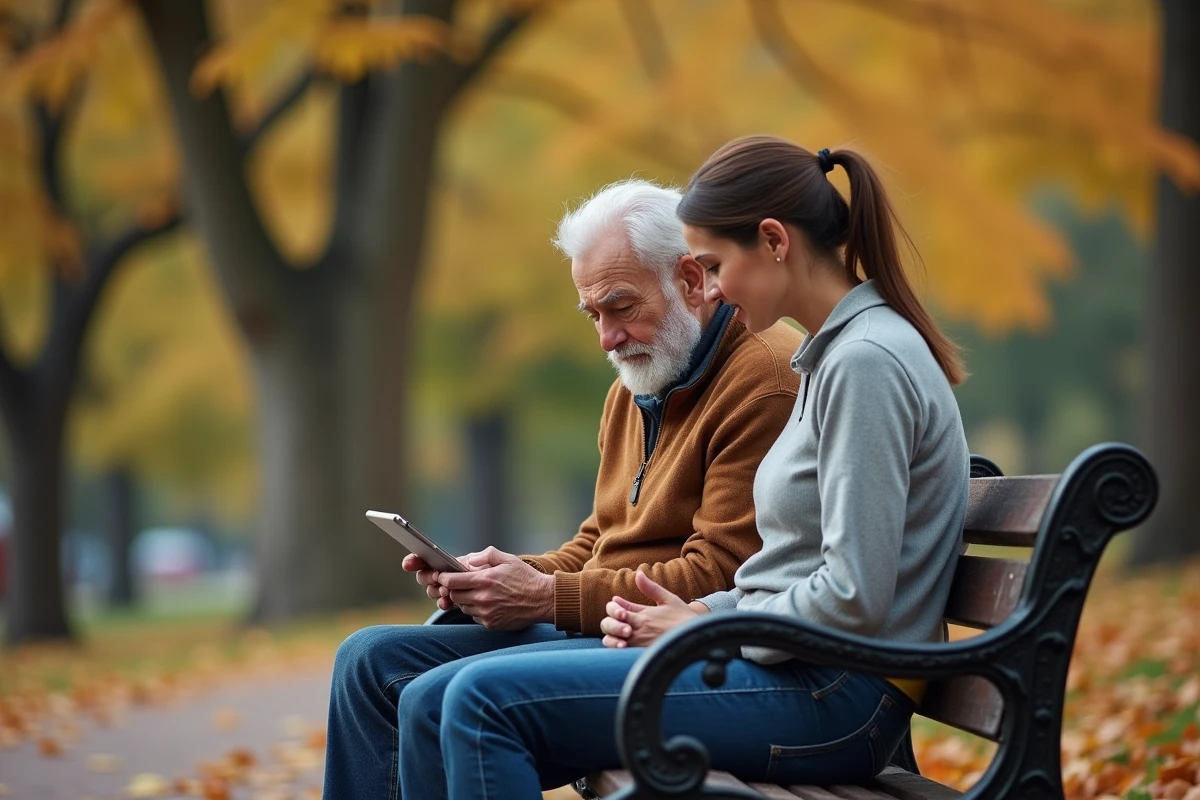
Simplified tablets allow seniors to maintain visual contact with distant loved ones. Video calls, when the interface is intuitive enough, partially compensate for physical absence.
Some municipalities and intercommunalities also organize friendly visits by trained volunteers. These programs often exist without families being aware of them. A call to the CCAS (Centre communal d’action sociale) of the municipality is enough to find out what is available locally.
Supporting a senior on a daily basis ultimately relies on three pillars: safe housing, attention to early signals, and regular human connection. No technology can replace the visit of a loved one who takes the time to notice what has changed in the refrigerator or in their gait.